
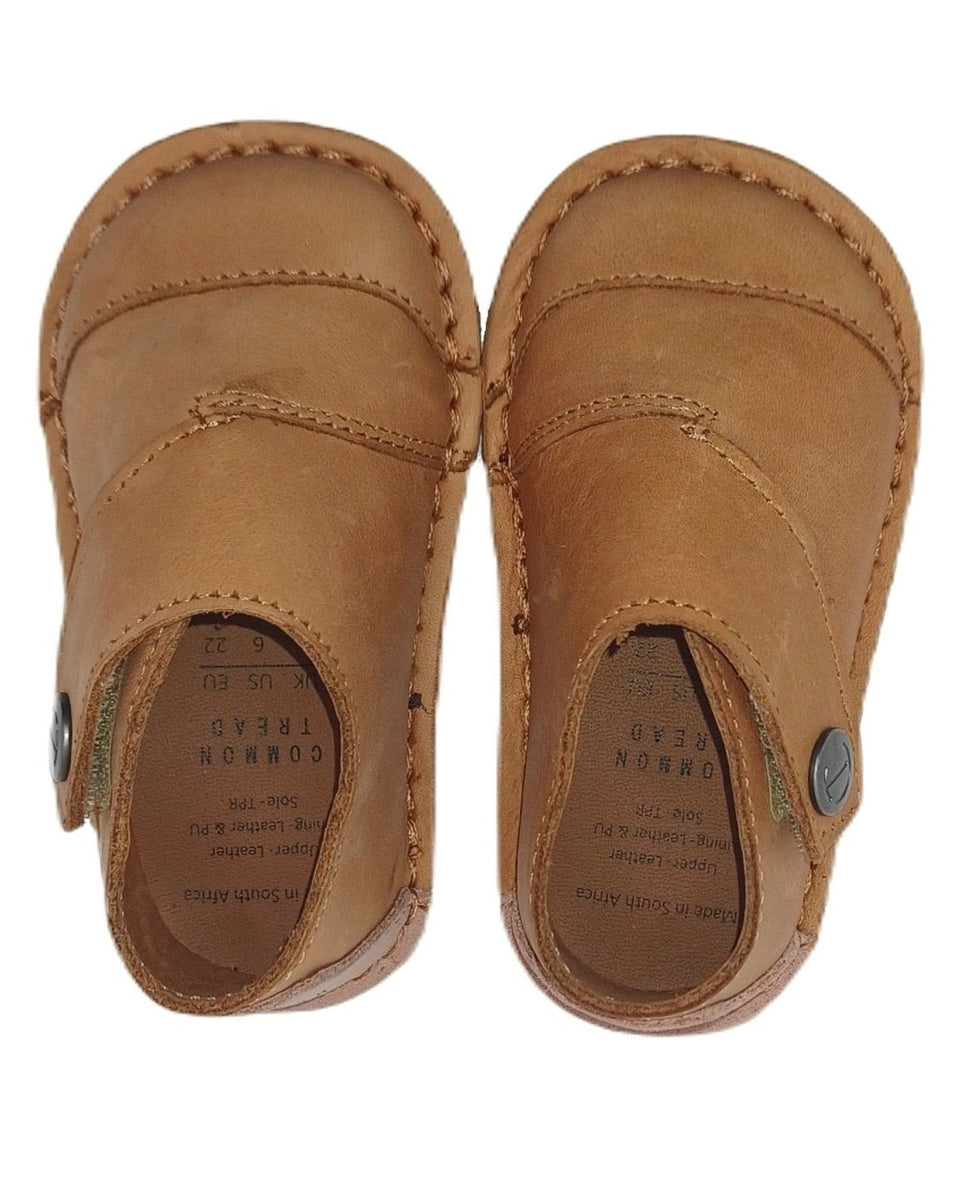
Closed-toe
The Evergreen
$65 · US 5–10
If they fall between sizes, size up.

A buying guide
A foot-shaped front, not a longer size.
At the creek
A wide toe box follows the shape of a child’s foot: broad across the toes, not pinched to a point. It is not the same as a bigger size, and it is not the same as a shoe that is simply marked “wide.” This guide shows you what that shape looks like, how to check it at home with a paper tracing, and where the Evergreen ($65) and the Amber Desert ($60) sit among our barefoot shoes for kids, in US sizes 5–10.
The shape
Look at a child’s foot from above. It is usually widest at the toes and narrower at the heel — more like a fan than a wedge. A foot-shaped toe box follows that outline, so the toes can lie flat and wiggle. A tapered toe box is often widest behind the toes and narrows to a point, which can press the toes together even when the length is right.

The Evergreen, our closed-toe leather shoe, is built with that rounded front. In the pair here you can see the last stays wide where the toes actually sit, rather than coming to a point.

Rounded and wide at the front, following the outline of the toes.
The leather is stitched to a thin, flexible, zero-drop sole.
An adjustable strap, so the shoe can close securely without narrowing the toe box.
A soft tan upper that holds the foot-shaped last.
The grey suede tab, stamped Common Tread, at the back of the shoe.
Side by side
The same foot, two shoe shapes. Drag the slider, or use the buttons, to compare. On one side, a typical tapered toe: the outline of the foot is wider than the shoe at the toes. On the other, a wide, foot-shaped toe box: the foot sits inside with space at the sides.
Pl. I A child’s foot, two lasts
The shoe narrows to a point. The toes have nowhere to sit but stacked or curled, even if the length looks right.
The shoe stays wide where the toes are. The foot outline sits inside, with a little room at the sides.

Once you know what to look for, a rounded front is easy to spot. In the photograph above, the sandal on the right is the Amber Desert, with an open, rounded toe that follows the foot. The closed shoes on the left also have a broad, rounded front. Shape is what you are looking for — not a longer size.
A test at home
Length and shape are two different measurements. For length, use the kids shoe size chart. For the toe box itself, a paper tracing is more telling than the number on the label. You need a sheet of paper, a pencil, a wall, and the shoe.
01
Place the paper against a wall. Have your child stand with the heel to the wall, weight on the foot, and draw around it, staying close to the toes. Use the longer foot.
02
You want a clear line around the toes and the sides of the forefoot — the widest part of the foot, not the heel.
03
Set the shoe on the tracing, lining up the heels. You are comparing the outline of the foot with the outline of the toe box.
04
If the tracing is wider than the shoe at the toes, the toe box is too tapered, even if the length looks right. If the tracing sits inside with a little space at the sides and a little room in front of the longest toe, the shape is doing its job.
Field note

A foot-shaped front leaves the toes room when a child is standing and balancing.
A common mix-up
No. Buying a longer size adds length first. It does not change the shape of the toe box. If the shoe narrows at the toes, a bigger size is still narrow at the toes — and it may slip at the heel.
That is a different problem from a foot that is wide, or from a high instep that makes a strap hard to close. Those are questions of width and volume, and we walk through them in our fit guide to barefoot shoes for kids with wide feet.
A longer size adds length first. It does not change the shape of the toe box.
Both the Evergreen and the Amber Desert are sold in US sizes 5–10, and they share one chart. Measure the longer foot, heel to toe, and let the length lead. Sizes below are US only.
| US size | Foot length | Up to |
|---|---|---|
| US 5 | 12.9–13.6 cm | 5.35 in |
| US 6 | 13.7–14.4 cm | 5.67 in |
| US 7 | 14.5–15.2 cm | 5.98 in |
| US 8 | 15.3–16 cm | 6.30 in |
| US 9 | 16.1–16.7 cm | 6.57 in |
| US 10 | 16.8–17.4 cm | 6.85 in |
If they fall between sizes, we generally recommend sizing up in the Evergreen. For the Amber Desert, which already has a bit of room to grow built in, we generally recommend the smaller size for a more secure fit. Choose from the current foot measurement, not a usual shoe size.
The two styles
Both have a wide toe box, a flexible zero-drop sole and easy Velcro, in US sizes 5–10. The Evergreen is the closed-toe shoe; the Amber Desert is the sandal. They are designed by Nicole, an occupational therapist, and John, an engineer, and handmade in small batches in South Africa.
Made in Cape Town Since 2020
Closed-toe
$65 · US 5–10
If they fall between sizes, size up.
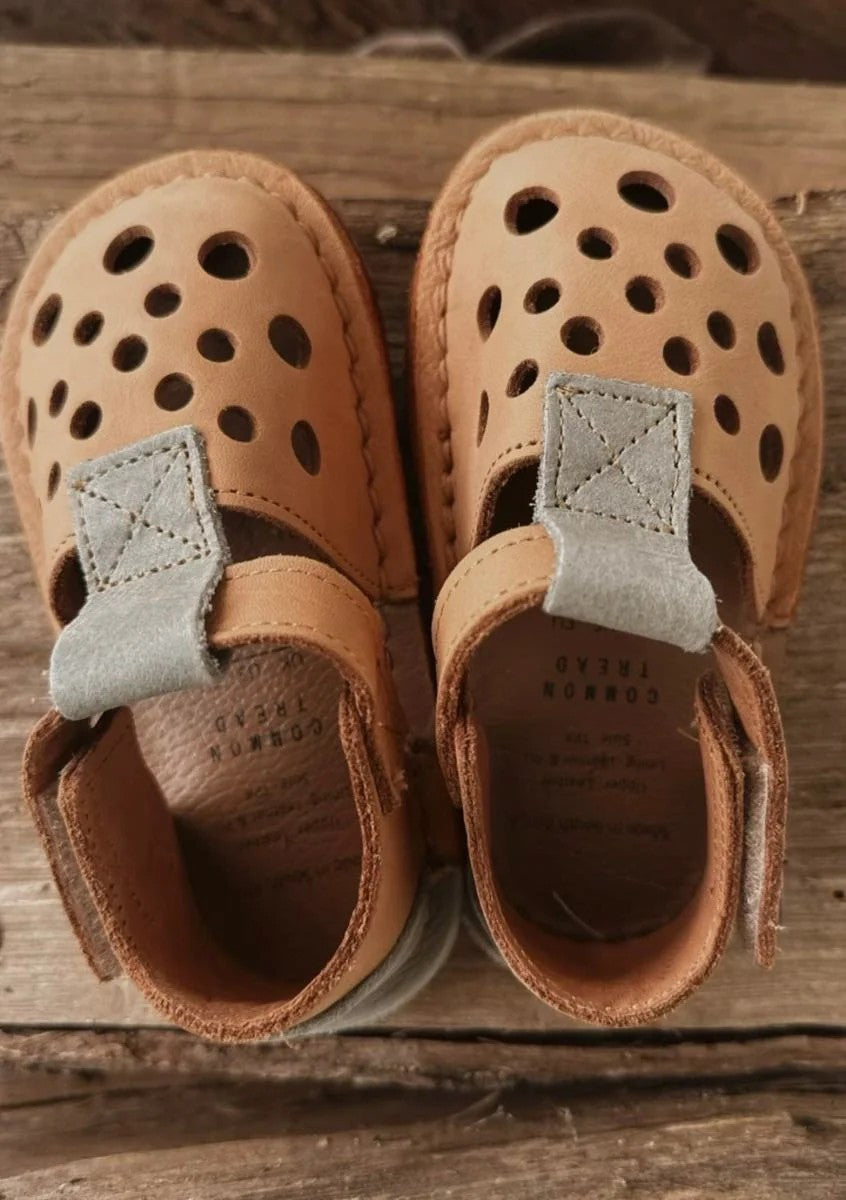
Sandal
$60 · US 5–10
If they fall between sizes, choose the smaller size.
Room in the toe box matters as much on a grass slope as it does on a porch step.
Out walking. Room in the toe box matters as much on a grass slope as it does on a porch step.

This page is about shoe shape, not a review of the research. If you are weighing the design itself, we answer are barefoot shoes good for kids in a separate guide.
FAQ
A wide toe box is the front of the shoe, shaped like a child’s foot: broad across the toes and rounded, rather than tapered to a point. It is a shape, not a size, and it is not the same as a shoe marked “wide.”
Trace the foot on paper and place the shoe on the tracing, lining up the heels. If the tracing is wider than the shoe at the toes, the toe box is too narrow. If the tracing sits inside with space at the sides, the shape is wide enough. You can also look at the shoe from above: a foot-shaped toe box stays broad where the toes sit.
No. A longer size adds length first. It does not change a tapered toe box into a foot-shaped one, and the heel may slip. If the tightness is over the instep rather than at the toes, that is a different fitting question, covered in our guide to barefoot shoes for kids with wide feet.
There should be a little room in front of the longest toe so the toes are not pressed against the end, without a sloppy heel. For length, measure heel to toe and match the kids shoe size chart. Both the Evergreen and the Amber Desert use that chart, in US sizes 5–10.
Both are offered in US sizes 5–10. On the chart, US 5 fits a foot 12.9–13.6 cm (up to 5.35 in) and US 10 fits 16.8–17.4 cm (up to 6.85 in). If they fall between sizes, we generally recommend sizing up in the Evergreen and choosing the smaller size in the Amber Desert, which already has a bit of room to grow built in.
The Evergreen is the closed-toe leather shoe, at $65, for warm or cool months, with or without socks. The Amber Desert is the leather sandal, at $60, for warmer months (and it can be worn with socks). Both have a wide toe box, a flexible zero-drop sole and easy Velcro. For more on the sandal, see our guide to barefoot sandals for kids.